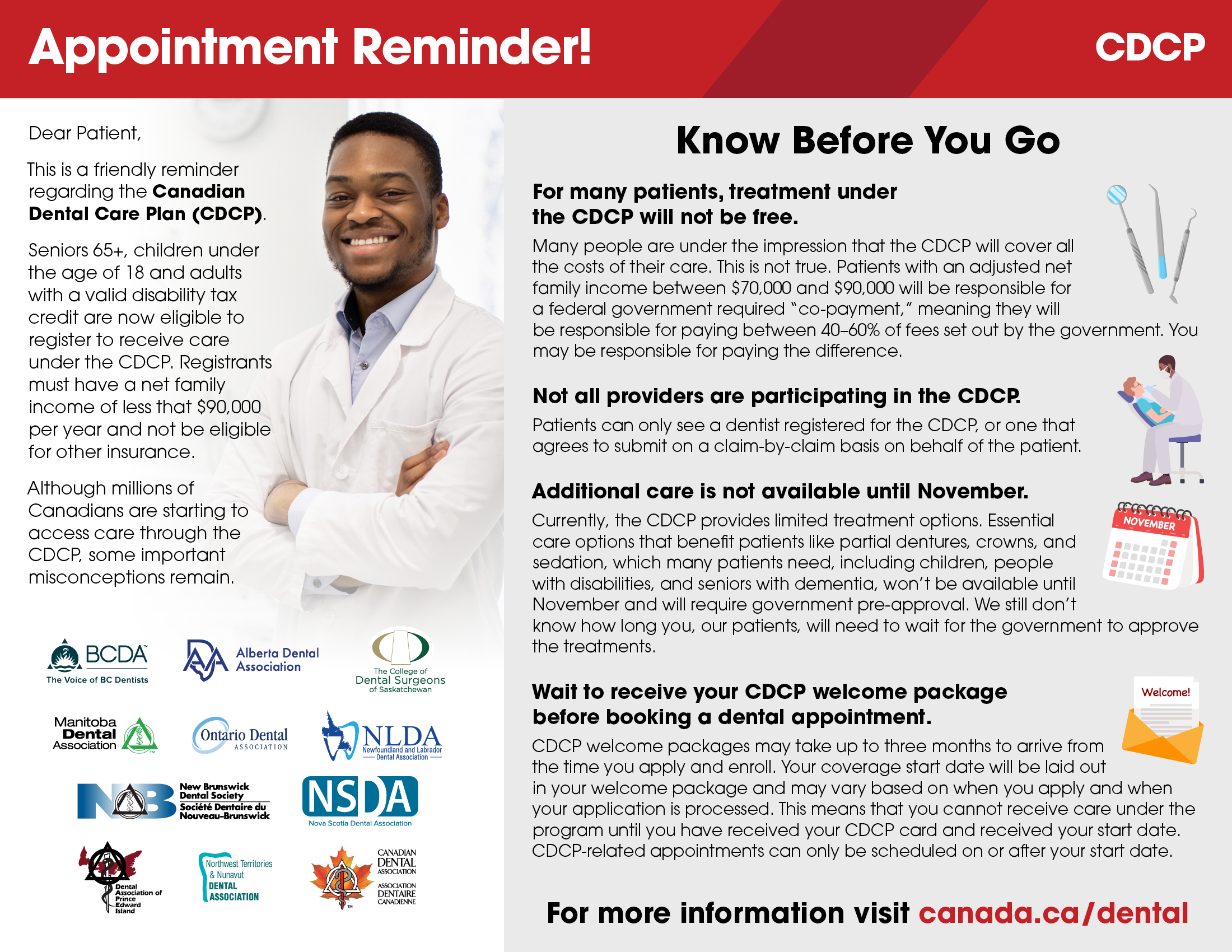
The Canadian Dental Care Plan (CDCP) is a federal government program designed to reduce financial barriers to oral health care for Canadians without existing dental coverage. It offers a subsidy for Canadian residents who do not have dental benefits and have an adjusted household income of less than $90,000 a year.
If you or someone you care for is eligible for the CDCP, here is what you should know before your next dental appointment.
Depending on your family’s income level, you may need to pay part of the cost, and there may be other charges associated with the service provided. The federal government will cover a portion of eligible fees, but you may be responsible for additional charges, known as co-payments. These out-of-pocket costs apply if:
Your adjusted family net income is between $70,000 and $89,999; and/or
You receive dental care not covered by the CDCP does not cover.
Below is the co-payment breakdown based on adjusted family income. Please note that e the CDCP fees may not be the same as what dentists charge. You may have to pay fees in addition to the potential co-payment if the cost of your oral health care services is more than what the CDCP will reimburse for these services; or if you receive treatment for services that are not covered by the CDCP.
Adjusted family net income
How much will the CDCP cover
How much you will cover
Lower than $70,000
100% of eligible oral health care service costs will be covered at the CDCP established fees.
0% of the CDCP established fees.
Between $70,000 and $79,999
60% of eligible oral health care service costs will be covered at the CDCP established fees.
40% of the CDCP established fees.
Between $80,000 and $89,999
40% of eligible oral health care service costs will be covered at the CDCP established fees.
60% of the CDCP established fees.
In addition to the co-payment requirements listed above, many of the established fees covered by the federal government do not meet the full cost of the treatment in a dental office. The difference will be on you.
Preauthorization Required for Some Services
Starting November 1, 2024, more treatments are available under the CDCP, including partial dentures, crowns and higher levels of sedation. These services require preauthorization from the federal plan, a process where specific treatments must be approved in advance to qualify for coverage from the federal plan.
While your dentist will recommend the best treatment , final approval is made by Sun Life and/or Health Canada. Preauthorization may lead to longer wait times, so it’s important to discuss options with your dentist in advance.
Wait For Your CDCP Member ID Before Booking
After you apply and are approved, you will receive a letter from the Government of Canada with your CDCP member ID, coverage start date and copayment levels if applicable. This letter will include your official start date, which determines when your coverage begins.
Dental care under the CDCP cannot begin until:
You have received your CDCP Member ID, and
Your coverage start date has passed
Appointments can only be scheduled on or after your coverage start date and with your Member ID.
Note: You do not need to wait for your welcome package from Sun Life to get care, as long as you have your letter with your CDCP member ID, coverage start date, and co-payment level with you at your first appointment. Your provider will need the information in your letter to confirm your coverage under the plan.
Frequently Asked Questions
CDA has long advocated for targeted investments to improve access to oral health care and we believe the Canadian Dental Care Plan (CDCP) will help improve access to care for many uninsured Canadians, especially for vulnerable populations.
CDA alongside provincial and territorial dental associations (PTDAs) and other stakeholders have worked diligently to provide insights and technical expertise to the government for the development and implementation of the CDCP.
We have emphasized our key recommendations from our February 2023 policy paper to guide the development of the CDCP, such as holistic oral health, patient-centred care, prioritization of preventative care, and support for existing dental offices by eliminating administrative burdens and ensuring that a strategy is in place to help address human resource challenges.
Lorem ipsum dolor sit amet consectetur adipiscing elit. Quisque faucibus ex sapien vitae pellentesque sem placerat. In id cursus mi pretium tellus duis convallis. Tempus leo eu aenean sed diam urna tempor. Pulvinar vivamus fringilla lacus nec metus bibendum egestas. Iaculis massa nisl malesuada lacinia integer nunc posuere. Ut hendrerit semper vel class aptent taciti sociosqu. Ad litora torquent per conubia nostra inceptos himenaeos.